Thursday, March 25, 2021

Low-tech transplant production

 We talk of building a greenhouse someday.  For our 17 years of farming, though, we've done without.  Maybe it's because the way we start transplants works good enough, is affordable, and is the low-tech homegrown way we strive for on our farm.  (Or maybe that's just what we tell ourselves because we don't know any better.)  Here's an overview:
 

Seeds are started in open plastic flats filled with our composted cow manure/sawdust near a south facing window (but not altogether even in the light of that window) in an upstairs room that gets warmer than the rest of the house.

Once the seeds germinate, they are moved out to our freezer cold frames for sunlight.  There is a wooden frame in each freezer that the flats rest on, bringing them closer to the top.  Below the flats are square 4 gallon buckets filled with water to provide extra thermal mass for buffering nighttime temperature swings. 

  While the freezer cold frames work really well to keep the seedlings warm during the day and comfortable at night when they're closed, we've learned a few things over the years.  First, we need to be around to adjust as needed.  If the sun suddenly pokes through on an otherwise overcast day, the glass needs to be moved to give some ventilation or the temperature can quickly rise too high.  Since the plants are sitting so close to the glass, there's not much temperature buffer once it gets sunny.  On windy days, it can be a bit tricky to balance enough ventilation without the plants getting too much air movement.
 Unlike the first freezer in the picture above, we think it's best to saw through the freezer hinges and completely remove the lid.  Otherwise, the underside of the lid, which is plastic, will degrade in the sun and fall apart prematurely.


   After the plants in flats get big enough, we transplant the cold tolerant ones (like lettuce, cabbage, chard, etc.) into our nursery bed.  This is simply a temporary -- we move our nursery bed around from year to year --  cinder block raised bed in the garden.  Storm windows are taken on and off to provide extra heat as needed.  And on really cold nights, the beds are also covered with blankets.  We also direct seed the same crops into the nursery beds for a later succession of plants.
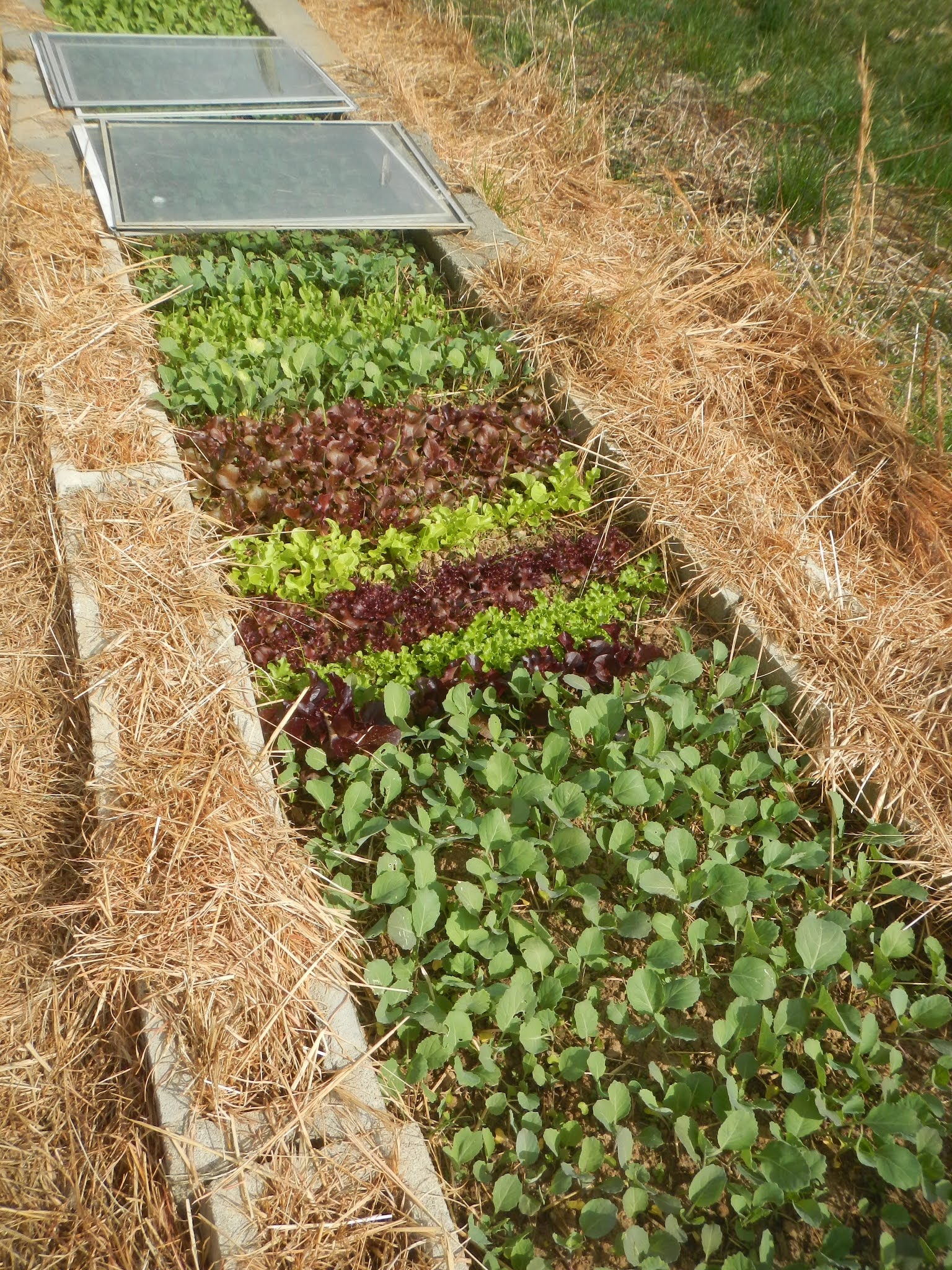
  Once the plants are big enough, the plants are simply dug up bare root and moved to the garden.  The best part of nursery beds is that the plants can be held until they are needed.  And if it ends up we have more plants than we need, then the small leaves of some of the crops can be harvested for salad greens directly from the nursery bed.


  Another nursery bed that has worked really well for us is our onion bed.  Onion seeds are planted in the fall and the glass is kept on all winter (with special attention to make sure ice and snow don't break the glass.)  By mid-March, the onion plants are pencil sized and ready to be set out.  We also use a nursery bed like this to start our sweet potato plants, except we fill the whole bed with sawdust instead of planting into the soil.
 

  For less cold tolerant transplants, like tomatoes, peppers, eggplant, and a miscellaneous overflow of other plants in flats and pots, we have a cold frame on the south side of our house.  On the coldest nights, we cover the glass with blankets.
  We're no experts on this and are still figuring things out, but this is an evolving system that we're using 17 years into our very small-scale but full-time farm.  It's a very low-cost, low energy system built largely around reused materials (storm windows, broken freezers, cinder blocks...) that we've mostly gotten through free stuff ads on the internet.


Monday, March 22, 2021

Pea tips


   Pea tips are just the most recent growth, including leaves, of pea plants.  They taste similar to actual peas.  We normally eat them raw, sometimes mixed with other salad greens.

Friday, February 19, 2021

Sweet potato tasting

  We tasted and scored 24 different sweet potato varieties last week.  For individual photos of each variety, click here.

  The highest average scores went to two varieties that haven't been at the top before, one that's been good but not at the very top before, Kyushu 100, and another that we had just grown for the first time, Saffron.  Kyushu also received the most 1st place votes. 


Other 1st place votes this year went to Faux Beau, Red Japanese, and Kotobuki.  Tennessee Red had the third highest average score after Kyushu and Saffron.  As usual, Covington and the purple fleshed varieties scored at the bottom of our taste test.  Covington is the most common variety sold in supermarkets, and although there's nothing wrong with the taste, there are definitely better tasting varieties, and we really don't like the baby food texture of Covington as a baked potato.  We do like Covington for other uses, however, like deep frying for potato chips, but we only compared baked potatoes for our taste test.  The purple fleshed varieties might also be pretty good in other uses.  They're not especialy sweet, and maybe there's some bitterness to them, which at first we find off-putting, especially in a blind taste test where we're expecting an average sweet potato, but that slight bitterness or whatever that flavor is might actually be good in some things.  We're thinking it might be good in the sorts of savory dishes that sometimes include unsweetened cocoa, for example, like chile.  In any case, they add striking color.  Nancy Hall, which has been our overall favorite more years than any other variety, was good this year but not as outstanding as it usually is.

  Having done these annual sweet potato tests for about 15 years now, it's remarkable how much variation there can be from year to year.  Besides the varieties already mentioned, other varieties that scored well in this year's taste test included Gem, Kotobuki, Suwan, Porto Rico, White Bunch, Scott Orange, White Triumph, and Murasaki.  PI 267946, which was among our overall favorites last year, is a variety we've definitely been enjoying this winter, but for some reason it didn't score very high in this taste test.  And although Woksaken didn't score high, that may have more to do with it being unexpectedly different rather than it not being as good.  It has a very dry, almost flaky texture, rather like a baked russet Irish potato.


Gardening in wooden shoes


 Have you ever worn wooden shoes?  Before my 44th birthday I had never worn them either.  Now I wonder how and why I waited that long.  Come to find out, they are great garden shoes.  They easily meet my garden shoe requirements of being mud/water proof and are easy to get on and off.  Even better, they can be made to fit to near perfection with some basic wood carving tools.  They offer great protection for your feet, too.  And best of all, they're made entirely of natural material -- nothing but solid wood -- and at the end of their life they won't end up in a landfill like all of my previous worn out garden shoes.
  My pair came from a tourist store in Holland, MI that resells Dutch made wooden shoes.  Someday, maybe we'll carve our own shoes.  (We just need to find a simple hand tool we can use for hollowing out the inside.)  They came with the traditional pointed shoe tip, which I recently decided to sand off, thus the temporary white tip until my garden work stains it back to garden brown.

Tuesday, February 16, 2021

Stepping through mud season on the farm


 With so many feet (and paws) traveling the paths of our farm, it doesn't take long for the walkways to become very muddy during rainy weather.  We think we've found a low-tech renewable solution: oak stepping "stone," from a neighbor's tree that blew down in a storm a few months ago.  Hopefully they are rot-resistant enough for the heartwood to last many years, but we'll see.


Monday, February 8, 2021

In the mood for some pumpkin pie?


  We still have plenty of our big heirloom pie pumpkins left.  Their bright orange pulp tastes great in pies, soup, and muffins.  To cook, simply quarter the pumpkin and put on rimmed baking sheets.  Bake at 350 for a couple hours then scoop out the flesh.  Don't forget to drink the juice - it's a sweet warm drink.  The pulp freezes great for later use.

Wednesday, November 4, 2020

The life of an onion

These are onion seed heads we harvested mid-summer and let dry down.
These are the onion seeds (black dots) with chaff.  It's often not necessary to get homegrown seed perfectly free of chaff.  In this case, the chaff and seeds will all get planted without issue.
We planted those seeds yesterday in an outdoor bed.  This is a little later than ideal, but the onions will be fine.  The seeds were planted in rows and covered back with dirt.  We watered them in and covered the bed with old storm windows to act as a mini-greenhouse.  They should start to germinate in a week or so.  They will grow some more this fall then pretty much go dormant all winter.  Come late winter they will finish growing into pencil sized onion plants we will transplant out in garden beds.  They will make bulb onions around June/July.  We planted Red Stockton and Yellow of Parma seed we'd saved and purchased Walla Walla seed.
As we harvest bulb onions during the summer , we set aside three dozen or so of the biggest and nicest shaped of each variety for seed.  These we bunch up and hang in an outbuilding until fall.
Then late October/early November we plant these bulb onions in a garden bed.  They will grow a little in the fall then become dormant over the winter.  Late winter they will grow into what looks like a bunch of green onions.  Then in early summer they will send up flower stalks.  Then they will flower and set seed.  Once the stalks are mostly dried down, we'll collect the seed stalks and heads to dry for the rest of the summer.  Those seeds will then be used to plant onions in the onion cold frame in the fall, and so the cycle continues.