If you believe, like we do, that there are lots of important
questions -- important enough that they deserve meaningful attention
-- that go into growing food and bringing it to the table, and that
the cheapest way (with or without any set of rules like those of the
National Organic Standards Board) isn't automatically and always the
best way (subjects we've previously discussed in more detail here
and here),
then you may have come to the same conclusion we have: that real
power to make meaningful choices in these questions comes by
connecting much more closely to the source of your food. And in
that case, if you've considered all the different parts of your
diet, you've probably found a very substantial list of food
categories for which there just aren't any real options for sale
anywhere in our broader area. In other words, if you live in this
area (or pretty much any other area in the industrialized world),
there are lots of foods/food categories you just can't buy except
from the supermarket system of agriculture. Obviously some foods,
like tropical fruits or new foods like margarine are by their very
nature not foods one should expect to be able to source from local
farms, but our list below is a list of foods that,
although challenging and complicated in various ways, we're fully
able to grow for our own use, foods which also were mostly commonly
available from local sources until just the last couple
generations. So, first the list of 9 things we're able to grow to
the full extent of our own family's needs but which can't be bought
from any comparable local-organic sources:
1. Buckwheat (particularly in contrast to rice...)
2. Dry peas/beans
3. Cow's milk, yogurt, butter, ice cream, mozzarella...
4. Goat's milk cheese and goat's milk (and goat meat)
5. A full assortment of local-organic fruits
6. Bread (and pancakes, biscuits, cakes, pasta, pizza, etc.)
7. Pork (and lard, bacon, ham...)
8. Nuts (so far: peanuts, black walnuts, chestnuts, and American hazelnuts, besides pecans we get from friends)
9. Corn tortillas
This would get too lengthy for our newsletter if we gave even a
brief explanation of each category on our list, but there are lots
of details to consider. If you have questions about why we say none
of these things is available to purchase from local-organic sources,
please talk to us about it further, but we'll summarize by saying
that those items which are available locally mostly either involve
substantial organic compromises (especially with animals raised on
non-local, non-organic feeds and often conventionally medicated as
well) or aren't complete enough that we would consider them full
substitutes (as with the limited supply of local-organic fruits and
nuts.) We'd also note that we're attempting with our new-this-year
Full Farm CSA plan to offer some of the above products to our Full
Farm CSA members, but our point is that even though these foods can
be grown, none of them is actually being grown for sale to the
general public.
We place buckwheat at the top of our list because, although for
most people and for us as well it's not a major staple, it played a
leading role in motivating us to more carefully consider the whole
range of foods that we had previously contented ourselves to buy
from more convenient sources. A few years ago we had decided that
if we were going to buy any foods from the supermarket system of
agriculture that we would at least buy USDA organic, but when we
ordered a bulk bag of organic buckwheat our bag of USDA organic
buckwheat came labeled "Product of China." For a number of fairly
obvious reasons this made it clear to us that the challenges and
costs of growing crops like buckwheat, dry beans and peas, a full
assortment of grain crops, the feed for our animals... were worth
taking on, and for the first time last year, although we failed to
harvest as much as we hoped, we did harvest enough buckwheat to meet
all our own family's needs. We hope to learn from some of last
year's failures and harvest enough to supply all our Full Farm CSA
members this year, but in any case, buckwheat represents many of the
common grains and grain products (rice, oatmeal, boxed breakfast
cereals...) that as a category are simply left out of the whole
local-organic food movement.
We'd like you all to especially consider that while things like
buckwheat and tortillas and the wheat that goes into making bread
and the feed that goes into making pork... are things that are easy
to overlook when there are lots of exciting local foods to focus on
instead, the crops on the list above (and their conventional
counterparts) represent a huge part, probably a majority, of
the calories we consume and the acreage of farmland we use by
proxy. They certainly represent a majority, probably a very heavy majority, of what practically everyone in the industrialized world eats (regardless of diet preferences) if you add in the foods that our
family would like to grow for ourselves but so far haven't yet fully
managed, things (and more common counterparts) we've mostly either
done without or continued to buy from the supermarket system: very substantial amounts of feed for our poultry and eggs, salad
oil, cider, beer, soy sauce, millet, oats, mustard seed, fermented
sausages like salami, hard cheese...) [2017 update: we're now growing a full supply for our family of oats and mustard seed, still working to varying degrees on most of the others, except still basically just dreaming about fermented sausages.] In other words, even a
local-food-super-hero consumer with unlimited time and money still
couldn't eat even half of any kind of normal diet from local-organic
sources, particularly not counting by calories or by one's farm
acreage footprint. We also don't see that any notable changes are
likely to be made with any of the categories on our list above in
the foreseeable future.
As farmers that likely think about these issues more and
understand them more deeply than most of our customers this leads us
to think that if we can't do more than the local food movement is
currently doing and get beyond the trajectory that the local food
movement is currently on and find some realistic hope of tackling the bulk of our diet and the bulk of our farming footprint -- gradually and with time but with some kind of reasonable plan for accomplishing more than minor token changes -- then we
might as well give up now. And that's what a lot of farmers do when
they content themselves with selling just profitable niche foods to rich people -- things that make a plate or a menu look good and feel local but that replace very few conventional calories or acres -- or when they resign themselves to quit
farming for a living and just grow what they can for themselves.
But we really want to find hope in a real alternative; we just think
hope depends on a deepening of cooperation between farmers and
consumers. If we can grow for our family and eat the foods on the
above list, even if it's not feasible to sell them to the general
public, we (and other small farmers that would eat a full spectrum
of the same kind of food they would grow) should be able to find
ways to grow a pretty full diet for those customers that share our
values enough to want to cooperate deeply with us and let our way of
farming re-define how they eat in the same way it has defined what
our family eats and our agricultural footprint. Increasingly this
goal is the focus of what we're growing and how we're selling.

Monday, July 20, 2015

Wednesday, June 10, 2015

A cup of tea
We enjoy a lot of tea here, hot in the winter and cold in the
summer. A half-gallon jar full usually waits for the thirsty on the
counter. Sometimes it's the bright red of roselle (hibiscus) and other
times it's the faint green of mint, both lightly sweetened with honey.
For no particular reason, we mostly pair lemongrass with stevia. And we
were excited to add tulsi basil to the mix last year with its
licorice-like flavor. New in the garden this year are anise hyssop,
catnip, chamomile, lemon basil, and bergamont. We are looking for good
flavors in tea and these all come recommended. Our basic method for
herbal teas is to harvest a handful of the herbs we want (sometimes a
mix), bring the water to a boil and let it sit for just a couple
minutes, and then pour the water over the contents in a bowl. We give
it about 5 minutes to steep then pour the liquid through a fine sieve
into a half-gallon jar (using a canning jar funnel), then sweeten with
honey (if we didn't already use stevia). All of these teas we also dry
so we use the same method, just taking out a comparable amount of the
dried herbs. We've mostly been content with teas we could grow, but
Melissa still had cravings for black tea. Maybe it's the cream and
honey that pair so well with black tea or maybe it's the caffeine! In
any case, years ago we planted a 4 inch tall Camellia sinensis (Chinese
tea), the camellia from which regular black and green tea are made. C.
sinensis, although it sizes up slowly like other camellias, does fine
here. It's hardy enough to take the winters and has no pest trouble that
we know of. It's evergreen with small leaves and pretty but not showy
white flowers. Regular harvesting actually helps promote a compact
bushy habit. Our bush has now reached 6 feet tall and 3 feet wide and
we were overdue to actually put it to use. We're a bit hesitant to
share our process because we're still very much experimenting. If you
have any personal experience processing C. sinensis from fresh leaves,
we'd love to hear from you. The basic process we followed for regular
black tea was to harvest new growth, the youngest two or three leaves.
Then we laid the leaves out to simply wilt for a day. This helps the
leaves become more pliable for the next step of rolling/crushing them.
By doing this, the now bruised leaves begin to darken, somewhat like
bruised basil. We left the leaves out on a tray for another day and
then finally put them in the dehydrator to completely dry out. And the
result for us: a light brown liquid with the characteristic bitterness
of black tea and for someone who rarely consumes caffiene, a bit of a
caffiene jolt! It was delicious, especially with cream and honey. We're
planting more Chinese tea as well as herbal teas and hope to soon be
able to help you more regularly enjoy a good cup of local Chinese tea.
In the meantime, be sure to try the tulsi and roselle this year if you
haven't already, and, of course, enjoy the mint, too.
Forcing mushooms


Thursday, April 16, 2015
FARM UPDATE


It's been a while since we've shared much news from the farm. One very visible project we've been at work at through the winter has been felling trees. Our property is over half woods so we're slowly trying to open up land that is closer to the house and barns to convert to pasture. Of course, livestock require a lot more care and time than timber, so it makes sense to keep the animals closer. We were also motivated to start working on clearing land adjacent to the electric line right of way after the power company came through to do their periodic clearing. We realized that by clearing land adjacent to the right of way we weren't just gaining more usable land there, but we were also eliminating the need for the power company to run its big equipment through the right of way itself, allowing us to make better use of that space as well. We generated a lot of firewood from the project which will keep us warm for a long time. Some of the wood was put to good use inoculated for shitake logs. And some of the logs headed to our friend's sawmill where he's sawing them into boards to be used for a number of projects on the farm, including better housing for the combine. Other logs, like sycamore, walnut, and cherry we have hopes of selling to furniture makers or possibly doing some fine woodworking ourselves.

 But for as many trees as we've cut, we've probably planted even
more. Eric has a continuing passion for fruits and nuts and continues
to plant the farm to edible trees and bushes. You can't walk far on the
farm and he'll point out something he's planted or grafted in place to a
volunteer seedling. Persimmons, figs, pomegranates, hardy citrus,
improved black walnuts, chestnuts, mulberries, apples, pears, pecans,
jujubes, pawpaws, blueberries (20 different varieties at that!)... most
anything that might be able to survive and produce in our climate is
being trialed, and we're expanding those plantings that have already
shown promise. So this early spring included walking around to find
space for more, and then more planting and more grafting. The tame (but
thorny) blackberries have proven themselves easy maintenance and
delicious so we planted a long row of them near the now cleared power
right of way. Figs are a great treat but the chickens think so, too.
So we found a space for more of them in a fenced in garden space.
Unfortunately, for the second year in a row now, winter was cold enough
to seriously injure the figs, so they've been set back again.
But for as many trees as we've cut, we've probably planted even
more. Eric has a continuing passion for fruits and nuts and continues
to plant the farm to edible trees and bushes. You can't walk far on the
farm and he'll point out something he's planted or grafted in place to a
volunteer seedling. Persimmons, figs, pomegranates, hardy citrus,
improved black walnuts, chestnuts, mulberries, apples, pears, pecans,
jujubes, pawpaws, blueberries (20 different varieties at that!)... most
anything that might be able to survive and produce in our climate is
being trialed, and we're expanding those plantings that have already
shown promise. So this early spring included walking around to find
space for more, and then more planting and more grafting. The tame (but
thorny) blackberries have proven themselves easy maintenance and
delicious so we planted a long row of them near the now cleared power
right of way. Figs are a great treat but the chickens think so, too.
So we found a space for more of them in a fenced in garden space.
Unfortunately, for the second year in a row now, winter was cold enough
to seriously injure the figs, so they've been set back again.

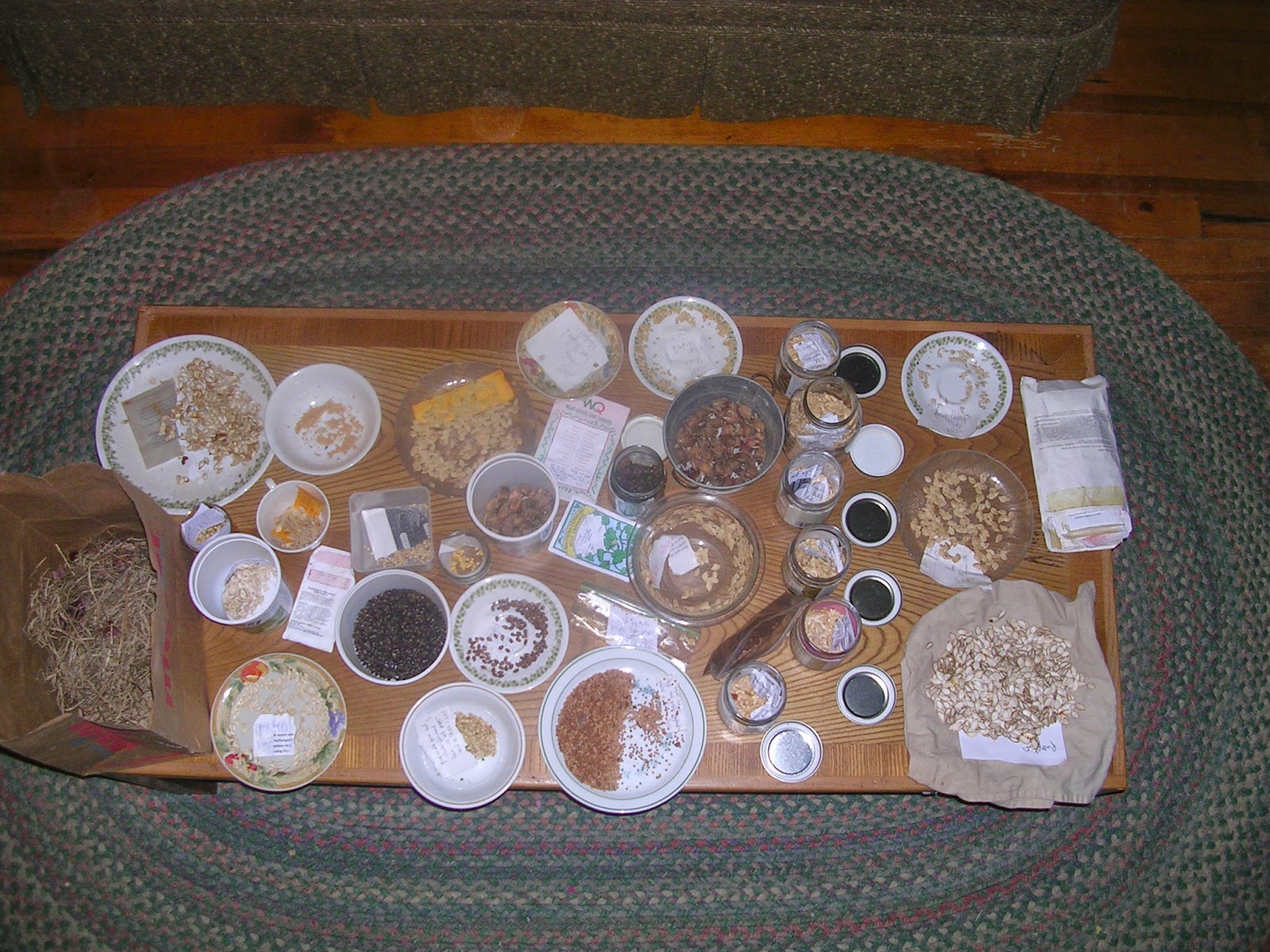 |
| Just some of one year's seed saving efforts |
 |
| Can you guess which one is the goose egg? |
 |
| Red corn tortilla chips and salsa |
 |
| Slicing sweet potatoes to fry for chips |
 |
| Frying sweet potato chips |

Wednesday, April 15, 2015
New arrival


This broody hen hatched our first gosling of the year for us. The geese deserve some credit, too!
Subscribe to:
Posts (Atom)