
Thursday, September 5, 2013
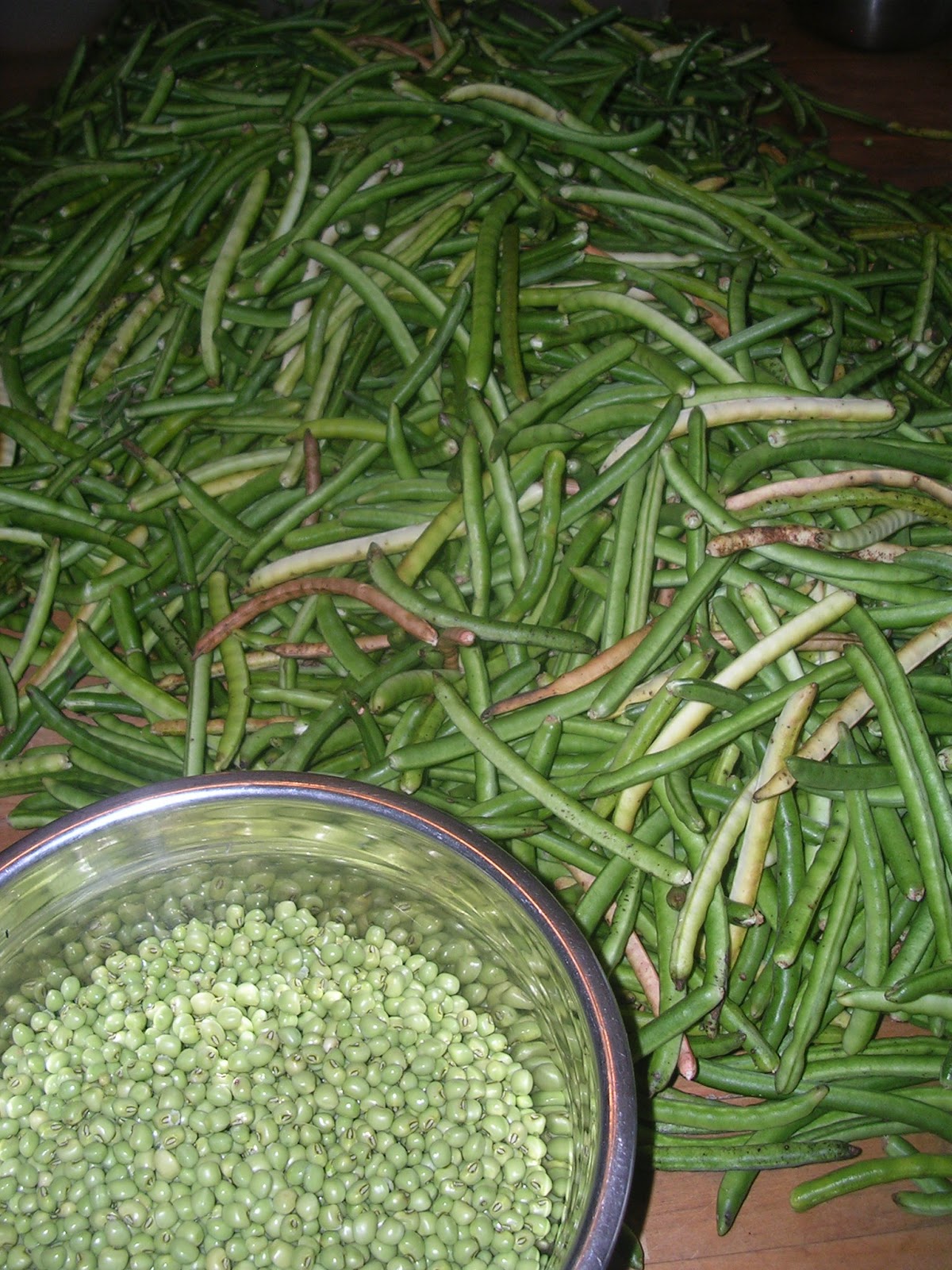
Piles of peas

FRESH POPCORN

We popped our first batch of fresh popcorn today and oh was it good. We grow an heirloom variety (which is basically the opposite of a hybrid) called 'Pennsylvania Dutch butter flavored.' Eric especially likes it at this stage before it's really ready. After another couple weeks of air drying it should pop fully but at this in-between stage some kernels will fully pop but others will only halfway pop. Eric thinks the popcorn flavor seems concentrated in that minimally popped kernel, and he loves the extra crunch. If you follow Eric's example you'll probably break a tooth, so if you don't want to break a tooth don't do it, and if you do do it, let us know how you like your popcorn.
Friday, August 30, 2013
At our table this past week
Eating very local is possible and enjoyable. We thought it might be inspiring and maybe informative to share photos of our meals occasionally. Here's a look at our table over the last week (maybe more). Not every meal is documented as many meals are leftovers and I don't think any breakfast shots got taken either. Confession - breakfast is probably our least local meal of the day. While we have a good rotation of breakfast items, many of them are based on wheat or oats, both of which we currently buy. We have raised wheat and harvested it so the goal of local organic wheat is hopefully around the corner. [As of 2018 we've been growing all our wheat for several years and oats not as long, but not yet enough oats to meet all our needs.] And we do enjoy a good share of corn mush or grits with our own bacon, goat cheese, and tomatoes for breakfast or our yogurt with fruit and nuts. Anyway, hope this all makes you hungry for some local food.
 |
| It's funny to look back and see what I actually came up with for a meal! I'm (Melissa) pretty much the sole cook here though Nora is in training and Eric is king of waffles. Three times a day there are 6 of us to feed (plus a WWOOFer at times). I try to think ahead with some menu plans - at least having some meat thawed, but often I'm less than an hour away from a meal with NO idea what will go on the table. There are no boxes of instant mac and cheese in the kitchen. I remember this meal was a last minute idea. Leftover grits, some shitakes the slugs had eaten on -- what we call "farmer grade" -- and my own craving for spring peas (out of the freezer.) I often feel like a cook on the cooking challenge shows with the extra challenge of two little ones crying with hunger on my legs. Anyway, a white sauce from our milk with our onions and shitakes and frozen peas from this spring. |
 |
| I have way too many cookbooks that I often scan for ideas. But talking about food to customers is equally inspiring. A CSA member upon looking through his box noticed eggplant. Hesitantly he asked, likely not knowing what to do with them, can you roast these like with onions and such? Yes I said and suddenly had plans for our own meal that night. Peeled and cubed eggplant seconds, small potatoes, and onions that were getting soft all tossed in plenty of our butter and some pesto from a batch I was making with basil leftover from the market roasted until soft. |
 |
| Bread - made with organic but not local wheat. Sweet corn our neighbor grows and gives us. Sliced venison from from a deer a neighbor gave us. Our tomatoes and beans. Elsea's milk. Homemade mayo with our egg but purchased oil. We have dreams of local oil and have even looked into manual oil presses available in Africa. But for now we try to enjoy our butter and lard as our main fat sources. Not so great for making mayo though. |
 |
| Okra, onions, and tomatoes on grits with our goat cheese. Now that the goats are in milk and we're making goat cheese again we seem to find a way to enjoy it with every meal. It's a very simple cheese - we simply add buttermilk and homemade rennet to the still warm milk and let sit overnight. Come morning, it is solid. We then pour it into a cheesecloth lined colander, salt and let sit in the fridge for 24 hours. Done! Oh, that paddy thing is a venison "burger." Somehow I got in my head to finely chop the rest of that venison roast in the food processor. Then added egg, flour, cumin and rolled it in cornmeal and fried. You'll have to ask the family what they thought of that idea! (Eric objected without tasting.) Oh, and the cumin wasn't local - yet. |
 |
| There's that venison paddy thing again! Trying to push off those leftovers. In any case, beans are usually a hit for the family. These are dried Oct. beans from our small harvest this year. Grits, beans and tomatoes. And goat cheese. |
 |
| Soup - I think some of that venison roast ended up in there, chopped up and added to our canned beef broth with some potatoes, carrots and onions. Cornbread and goat cheese! Probably some butter and honey, too, for a dessert slice of the cornbread. Maybe an extra pan of cornbread for the much loved breakfast of cornbread crumbled in milk with honey. |
 |
| Okay, there was that venison roast again this time cooked with okra and onions. It was a big roast, I think it was a ham that went whole in the freezer to be made into venison jerky at some point but didn't. With mashed potatoes, shitakes and the first of the summer peas - pink-eyes. And on the side, the first of the Asian pears, maybe a little under ripe but the chickens who pecked on them first didn't seem to think so. |
 |
| Nora's nick-name has long been Noodle so it's quite appropriate she's become the pasta maker. She is much more patient then I am. Here she's making spaghetti - our eggs, purchase wheat we ground in the mill. |
 |
| Worn out from pasta making or fun on the farm. In any case, the pasta with tomato sauce or pesto went over quite well. |
 |
| Even if you look at this picture up close I bet you'll never guess what Nora fried in the pan. Inspired by our friend from the Congo, the kids went on a grasshopper search, came home and fried them. And gulp, we all actually enjoyed them. |
 |
| I've been craving sweet potatoes. We used up our supply in late spring. So I was excited to pull some already decent size potatoes from a few plants and put them directly in the oven. Of course, some aging makes them much better but with butter and salt, they were good. Irish potatoes cause we have plenty of "farmer grade" ones. Tomatoes, okra and onions and our beef steak. And beer from a customer who makes it, bringing us beer when he comes to pick up his veges. It's time to harvest our hops for him. We have some barley hand-harvested, too, just needs to be malted for a really local brew. |
Monday, August 26, 2013
Swarm

Thursday, August 1, 2013
A Week on the Farm
 I was a little optimistic today and hung the clothes out to dry - it's
raining on them as I write. But we did have a small window of dry hours
this week and got some weeding done in the garden. I recall dry years
how "clean" the gardens look. This year, it's more like searching for
the produce among the weeds. By now we're getting a little used to the
rain. That said, Saturday's market downpour was like no market we've
ever survived. Thanks for coming out to support the farmers! Eric and
Nora came home a bit chilled, grateful for the kitchen I'd heated up
with canning tomatoes. It has been a tomato week since then. On
harvest days, Eric will bring in box after tray of them and I'll start
the processing line. Drop them in boiling water to peel for whole
tomatoes, slice onto a tray in the oven for roasted tomato sauce, cook
down in a pot on the stove for juice. It was music to my ears the sound
of sealing jars on the kitchen table. We've almost filled our shelves
with our needed supply, so now it's your turn to stock up!
I was a little optimistic today and hung the clothes out to dry - it's
raining on them as I write. But we did have a small window of dry hours
this week and got some weeding done in the garden. I recall dry years
how "clean" the gardens look. This year, it's more like searching for
the produce among the weeds. By now we're getting a little used to the
rain. That said, Saturday's market downpour was like no market we've
ever survived. Thanks for coming out to support the farmers! Eric and
Nora came home a bit chilled, grateful for the kitchen I'd heated up
with canning tomatoes. It has been a tomato week since then. On
harvest days, Eric will bring in box after tray of them and I'll start
the processing line. Drop them in boiling water to peel for whole
tomatoes, slice onto a tray in the oven for roasted tomato sauce, cook
down in a pot on the stove for juice. It was music to my ears the sound
of sealing jars on the kitchen table. We've almost filled our shelves
with our needed supply, so now it's your turn to stock up!
You may know, we are really into taste tests. While this is quite useful - helps us grow the best tasting varieties - it's also fun to blindfold someone and feed him something. Trust. This week it was blueberries. Now 5 years in the ground, our blueberry planting is starting to amount to something. Not sure which variety to plant, we planted 19! You'd think a blueberry is a blueberry, but taken one at a time and really tasted, there are good ones and really, really good ones. (Of course, it's also nice to have early- and late-yielding varieties to extend the fresh blueberry season.) Most members of the family chose the same top four varieties, with the overall winner for the Browns this year being a variety named 'Yadkin.'
New additions always brighten the mood around here and this week we welcomed our third kid, goat kid that is. All three have been nanny (female) kids this year. We found the latest kid in the pasture with her mother where she was healthy and had already figured out nursing. This was a reassuring sight after losing one of our goats about a month ago to late term pregnancy complications.
It's a delicious time of year outdoors. We find ourselves grazing around the farm - cherry tomatoes, blueberries, our first little crop of very organic-looking apples, big tame blackberries, raw beans (just Melissa), grapes, figs...
Thursday, June 13, 2013
Drowned
We had over a week ending earlier this week when it must have rained well over an inch on average every day. Fortunately, we didn't suffer any noticeable washing or other long-term damage, but we've never before stayed this wet this long in the middle of the growing season. In all but our very best drained soils that meant continually water-logged soils, and the roots of most garden plants can't stand that very long. So all the rain put an end to some crops, left others
rotten in the ground, and set us back on weeding and planting...
 |
| dead cabbage plant |
 |
| lots of dead cabbage plants (and other cole crops) |
 |
| dead bean plants |
 |
| rotting carrot |
 |
| the field corn still looks good but so do the weeds |
 | |
| it's not looking like a big crop this year but there's definitely honey to harvest |
 |
| the tomatoes are looking pretty good but we have more to prune and tie up |
Monday, May 20, 2013
Grafting
Eric confessed yesterday that he was done grafting for the year (but
this morning that's sounding a little too final). This may not sound
like a big deal, just another farm task completed, but then again,
you've probably never lived with an obsessive grafter. Let's start with
a quick lesson on grafting. In short, you connect a piece of wood from
an outstanding tree on any random tree and that transforms that tree
into an extension of that outstanding tree. Take an apple tree grown
from an apple seed, for example, and you'll get an apple tree that will
most likely produce a fruit not fit to eat. Now cut a twig off a good
apple tree and graft it onto the sorry apple tree and now it too will
produce wonderful fruits. It's an ancient practice, talked about even in
the Bible. While some of Eric's good wood comes from neighbors or a
remarkable tree found growing in a ditch somewhere, he gets most of his
wood sent to him through the mail. Yes, grafting addicts mail each other
twigs! These folks typically meet each other on a fruit forum chat
group. They discuss to exhaustion the pros and cons of all known
cultivars of mulberries, they console each other about the coming
emergence of the 17 year cicadas that could decimate their orchards,
they post pictures of their first blossoms of the year; they are fruit
and nut nuts. And they share wood. Often it's an exchange, you send me
this and I'll send you that. But sometimes they force their favorite
varieties on each other, like a package that arrived this spring full of
seedless native persimmon cultivars we just had to try. In any case, the
6 inch pieces of wood arrive carefully packed with damp paper towels
sealed in plastic bags labeled with names like Rosseyanka, Shinseiki,
and Thomas Myers. They are cut in the winter before the trees start to
grow and stored in the fridge until the trees they'll be grafted onto
are ready. Soon the fridge produce drawers are all taken up with twigs.
A friend suggested we could serve dinner to a family of beavers with all
the wood in our fridge!
In practice, it's interesting, especially when grafting season begins. First, he grafts onto potted plants to be planted out after the graft has established itself. At our house, many of these potted plants found their way into the house "because it's warmer in here and the trees will be ready to graft earlier." I envisioned delicious Asian persimmons and accepted, for a time. The other method is field grafting. Here you have a seedling already established in the ground where you want it, no need to dig a hole or to worry about watering transplanted trees. All you have to do is graft onto it. You simply turn a weed into food. Our pastures and fence lines are full of useless callery pears (with tiny bad tasting pears like the ornamental Bradford pears) and persimmons and mulberries of unknown quality and possibly non-fruiting male trees. So Eric has put wood of known pear or persimmons onto them, marked them with flagging tape (a reminder not to let the cows graze too close). But here there is less control as the elements can be hard on the delicate new grafts. Little tin foil bonnets protect the persimmon sticks until they get established. Many times a weeks, Eric takes the kids out on the graft march into the fields. They too can now spew off the technical terms: scion, stock, cambium, banana graft, bark graft, whip and tongue...
So grafting season is pretty much over. And now we watch as the new buds swell, turn green, and expand into new branches. Yesterday I was checking on the bean planting and Eric came over and asked if I wanted to go look at the nearby Hana Fuyu graft. Jokingly -- although he takes his grafts too seriously to have gotten the joke at first -- I immediately responded that I already had. Once the tree begins to fruit it will be another story: I'll be at least as eager for the fruit as he is to see his buds grow. Our farm is quickly growing into a forest of seedless persimmons, and sweet, crunchy Asian pears, thin-shelled black walnuts, big fat pawpaws, and delicious mulberries. We look forward to sharing, too.
In practice, it's interesting, especially when grafting season begins. First, he grafts onto potted plants to be planted out after the graft has established itself. At our house, many of these potted plants found their way into the house "because it's warmer in here and the trees will be ready to graft earlier." I envisioned delicious Asian persimmons and accepted, for a time. The other method is field grafting. Here you have a seedling already established in the ground where you want it, no need to dig a hole or to worry about watering transplanted trees. All you have to do is graft onto it. You simply turn a weed into food. Our pastures and fence lines are full of useless callery pears (with tiny bad tasting pears like the ornamental Bradford pears) and persimmons and mulberries of unknown quality and possibly non-fruiting male trees. So Eric has put wood of known pear or persimmons onto them, marked them with flagging tape (a reminder not to let the cows graze too close). But here there is less control as the elements can be hard on the delicate new grafts. Little tin foil bonnets protect the persimmon sticks until they get established. Many times a weeks, Eric takes the kids out on the graft march into the fields. They too can now spew off the technical terms: scion, stock, cambium, banana graft, bark graft, whip and tongue...
So grafting season is pretty much over. And now we watch as the new buds swell, turn green, and expand into new branches. Yesterday I was checking on the bean planting and Eric came over and asked if I wanted to go look at the nearby Hana Fuyu graft. Jokingly -- although he takes his grafts too seriously to have gotten the joke at first -- I immediately responded that I already had. Once the tree begins to fruit it will be another story: I'll be at least as eager for the fruit as he is to see his buds grow. Our farm is quickly growing into a forest of seedless persimmons, and sweet, crunchy Asian pears, thin-shelled black walnuts, big fat pawpaws, and delicious mulberries. We look forward to sharing, too.
Subscribe to:
Posts (Atom)