Despite the fact that we make our living farming, we only realized a couple months ago that major food safety legislation that will dramatically restructure our farming/food system had already passed the US House (H.R. 2749) last summer and is on the verge of passing the Senate (S. 510). As diversified, organic farmers we see some fundamental problems with the pending legislation,
(1) Diversity is seen as a threat: food safety is understood as keeping animals as far away from produce fields as possible. What that effectively means is large monocultures (where border issues are non-issues) and animals correspondingly confined to feedlots and confinement houses, whose manure then accumulates in tremendous quantities, far beyond the ability of the immediate ecosystem to safely absorb, and thus posing the most serious safety issues (as evidenced by the recent food safety scares, particularly the deadly food poisoning outbreak with spinach, as well as the most recent lettuce outbreak.) Diversified farms, after all, aren't causing the outbreaks we're hearing about and that have energized the push for new legislation; quite the opposite: large, monocultural farms are. Well managed plant and animal diversity is the friend of food safety (as well as the friend of a lot of other good things), not the enemy.
(2) Huge regulatory burdens are placed on the farm use of manure. But what's the alternative? Conventional fertilizers synthesized from fossil fuels and other non-renewable mined sources. Why should the risks of chemical contamination of produce (and of drinking water and other indirect paths) warrant so little attention? The science certainly isn't there to support, on the grounds of food safety, the hard push away from traditional uses of manure to chemical agriculture, and that's precisely the trade-off. What about synthetic pesticides? Are we supposed to ignore all the risks they bring with them, both to food consumers as well as to water resources, rural communities, and ecosystems? The reality is that synthetic fertilizers and pesticides go together. The only practical way to place all these limitations on the use of manure is to open ourselves up to more chemical risks and proven chemical harm.
Even then, using petroleum-based fertilizers doesn't mean we have any less manure to deal with; it only means more manure winds up in places where it's a worthless waste liability, which is where the greatest food safety risks lie. The sensible question isn't how to avoid manure but how to best incorporate manure into our agricultural system. (We might also ask if ways of keeping and feeding and medicating animals make for less pathogenic manure.) No matter how hard we make it for farmers to use manure productively, the manure still has to go somewhere.
(3) “Good Agricultural Practice” cannot be defined in a one-size-fits-all format, and especially not by Washington. There is zero scientifically proven risk to letting weeder geese into a sweet corn crop (i.e. letting domestic geese eat the competing weeds out from under an immature sweet corn crop), and no reason to even suspect food safety problems, but official GAP would outlaw the practice. What if some people would rather have some goose poop fall three feet under their corn before the corn even forms than to have the corn itself genetically modified and then sprayed directly with chemical herbicides? (Transgenic sweet corn has already found its way into the fields of vendors even at our little farmers' market.) Obviously, the use of weeder geese isn't common practice (at least not nowadays), but there are 10,000 other such innovate farming practices GAP would outlaw. The end effect of a legislative definition of good farming is that a great deal of innovation and unconventional ways of farming will be outlawed, particularly on the kind of small farms that generate the least run-off and waste liabilities, don't rely on illegal immigrant laborers, depend least on foreign oil, provide the most viable, long-term alternative to cost cutting produce from China or Mexico, produce food with the least chemical residues, expose farmers and farmhands to the least chemical dangers, necessitate less highway and air traffic, demand fewer square miles of land be paved over, etc., etc. Have we not gone far enough in pushing these kinds of farms out of business already?

Saturday, May 15, 2010

Monday, May 3, 2010
Farm Update

Here's some news from the off-season.
Winter held its grip without respite until well into March. We've had some unseasonably hot spells mixed in with the near frosts since then. Even last night, with a clear starry sky, we went to bed fearing how low the temperature would fall. Fortunately, at sunrise, it was 41, sparing the hopeful bumper crop of strawberries. We're also looking at an abundant spinach and lettuce harvest. The spring peas are coming on strong, but they're behind schedule. A cold, wet late winter had them planted the latest we've ever put them in. If it doesn't get too hot too soon they should still produce very well. The first of the beans and sweet corn, on the other hand, went in the ground earlier than normal. We're getting ready to set out our 300 tomato plants today.
The main honey flow has started with the tulip poplars, blackgum trees, and blackberries all in bloom. The air force is hoping for clear, sunny skies to make its crop of honey. The bees came through the winter very well, but the consistent cold delayed their spring population build-up. We're already busy making up lots of mating nucs (nucleus/starter colonies) for next year's honey crop.
Animal projects, in particular, like fencing have kept us busy through the off-season. We currently have two cows in milk, one of which is feeding a calf that we'll beef at some point this year. We also bought a little jersey heifer we named Dandelion for our future milk supply. The first calf born on our farm is now several hundred pounds of beef steer that we plan to finish on the high energy summer grasses. We're hopeful three of our nanny goats are bred for late summer milking. They and a fourth nanny continue to clean the brambles, weeds, and poison ivy out of our pastures and perimeters. The first of our hens hatched a clutch of biddies a few weeks back. She had been setting up in the hay mow unknown to us. She is successfully mothering her 16 biddies! Other hens have started setting as well. As we seemed to be getting ahead of the demand for eggs we sold down some of our flock. With over 50 hens remaining, though, we hope to have a good supply for the market season.
The other big news is that we are expecting our third child in mid-July. Fortunately, it has been a gentle pregnancy for Melissa, so we're moving forward with the season pretty much as normal so far. Of course, there will probably be some interruption when the baby arrives.
Wednesday, April 28, 2010
Low-tech germination

Until we build our dreamed of greenhouse, we've found old chest freezers to be a great way to germinate seeds. During the day, a piece of glass over the opening can easily send the temperatures over 100 degrees. At night, we shut the lids. Then a 60 to 100 watt bulb below the plants keeps the temperature quite cozey, between 70 and 80 degrees. Here flats of eggplant and pepper transplants enjoy the extra heat.
Tuesday, April 27, 2010
Hot house tomatoes
 The tomato plants are ready to go out. Every time we check the forecast though, it seems a better idea to keep them safe in their "hot house" a little longer. Tonight there is even a chance of frost. This after 80 degree weather a few weeks ago.
We have around 20 varieties this year. These include our favorites of Amish Paste, San Marzano Redorta, and Akers West Virginia. We have five different cherry types this year. And we're experimenting with a handful of new varieties, always searching for a new favorite.

Surprise chicks

We've just had the first of our hens go to setting, an exciting sign of spring. Broodiness in our hens is a chicken trait we are glad for as the mother often does a better job of incubating and raising little chicks than we do. So when we see a broody hen, we'll give her about 9 marked eggs and leave her to her 21 days of sitting.
Just after the first hen had gone to sitting the other day, I came in the barn to the sound of cheeping. After some searching I found a hen in the hay mow with 16 chicks! We had thought the hen had just gone missing. In fact, she had been busy sitting. We were thrilled with this first hatch of spring, the most chicks we've ever had from one hen.
Friday, April 23, 2010
Orchard
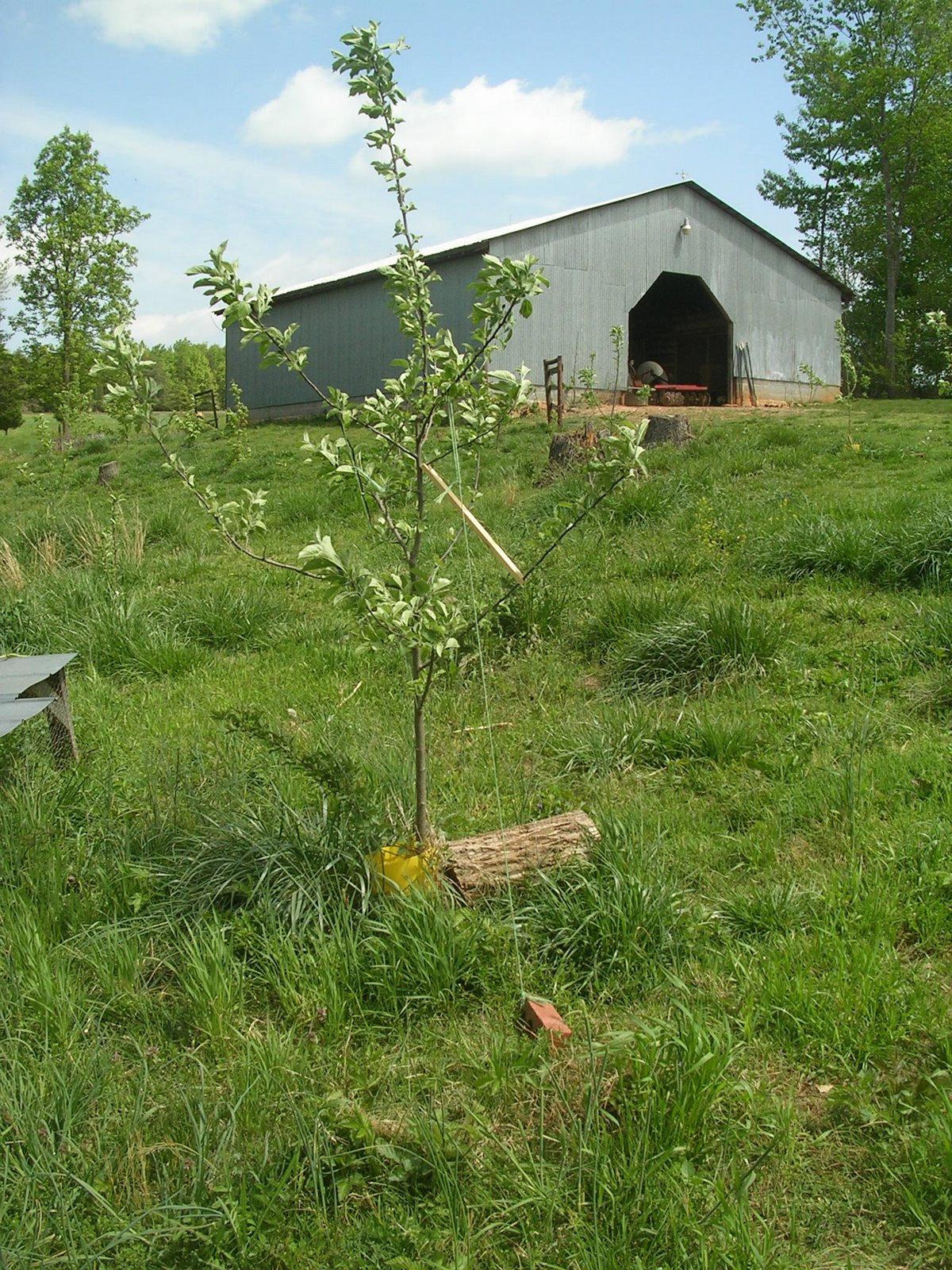 Within days of moving to our farm three years ago, we started planting fruit and nut trees. This spring, the orchard is finally starting to look like something. Many of the trees have grown over our heads (except the Asian pear the cow ran over) and some are putting out their first blossoms. This first planting is mostly an experiment to see what we can grow organically. We set out disease-resistant apples, some peaches, an apricot, some cherries, pears and Asian pears, persimmons, jujubes, figs, chestnuts and pecans. Along with these trees, we have grapes, blackberries, blueberries, and raspberries. We look forward to someday soon taking an edible walk around the farm.
Wednesday, April 21, 2010
Crimson Clover - Food for bees, cows, and garden
 Last fall, we sowed most every open space we had to crimson clover. Over the winter, it grew into a lush green mat, protecting the soil. Then this spring, it burst into bloom. But the clover is not only beautiful, it's a great food source for much of our farm. The bees have been busy working the blooms, collecting its nectar and pollen. In the pasture, Elsea and Mary May have been gorging themselves on it, resulting in increased milk production. We also cut some of the clover for hay, a treat for the girls this winter. And in the gardens the incorporated clover will decompose and provide valuable nitrogen for our garden crops.
Subscribe to:
Posts (Atom)