Monday, May 3, 2010

Farm Update


 Here's some news from the off-season.
   Winter held its grip without respite until well into March. We've had some unseasonably hot spells mixed in with the near frosts since then. Even last night, with a clear starry sky, we went to bed fearing how low the temperature would fall. Fortunately, at sunrise, it was 41, sparing the hopeful bumper crop of strawberries. We're also looking at an abundant spinach and lettuce harvest. The spring peas are coming on strong, but they're behind schedule. A cold, wet late winter had them planted the latest we've ever put them in. If it doesn't get too hot too soon they should still produce very well. The first of the beans and sweet corn, on the other hand, went in the ground earlier than normal. We're getting ready to set out our 300 tomato plants today.
   The main honey flow has started with the tulip poplars, blackgum trees, and blackberries all in bloom. The air force is hoping for clear, sunny skies to make its crop of honey. The bees came through the winter very well, but the consistent cold delayed their spring population build-up. We're already busy making up lots of mating nucs (nucleus/starter colonies) for next year's honey crop.
   Animal projects, in particular, like fencing have kept us busy through the off-season. We currently have two cows in milk, one of which is feeding a calf that we'll beef at some point this year. We also bought a little jersey heifer we named Dandelion for our future milk supply. The first calf born on our farm is now several hundred pounds of beef steer that we plan to finish on the high energy summer grasses. We're hopeful three of our nanny goats are bred for late summer milking. They and a fourth nanny continue to clean the brambles, weeds, and poison ivy out of our pastures and perimeters. The first of our hens hatched a clutch of biddies a few weeks back. She had been setting up in the hay mow unknown to us. She is successfully mothering her 16 biddies! Other hens have started setting as well. As we seemed to be getting ahead of the demand for eggs we sold down some of our flock. With over 50 hens remaining, though, we hope to have a good supply for the market season.
   The other big news is that we are expecting our third child in mid-July. Fortunately, it has been a gentle pregnancy for Melissa, so we're moving forward with the season pretty much as normal so far. Of course, there will probably be some interruption when the baby arrives.

Wednesday, April 28, 2010

Low-tech germination


Until we build our dreamed of greenhouse, we've found old chest freezers to be a great way to germinate seeds. During the day, a piece of glass over the opening can easily send the temperatures over 100 degrees. At night, we shut the lids. Then a 60 to 100 watt bulb below the plants keeps the temperature quite cozey, between 70 and 80 degrees. Here flats of eggplant and pepper transplants enjoy the extra heat.

Tuesday, April 27, 2010

Hot house tomatoes

The tomato plants are ready to go out. Every time we check the forecast though, it seems a better idea to keep them safe in their "hot house" a little longer. Tonight there is even a chance of frost. This after 80 degree weather a few weeks ago.
We have around 20 varieties this year. These include our favorites of Amish Paste, San Marzano Redorta, and Akers West Virginia. We have five different cherry types this year. And we're experimenting with a handful of new varieties, always searching for a new favorite.
Posted by Picasa

Surprise chicks


We've just had the first of our hens go to setting, an exciting sign of spring. Broodiness in our hens is a chicken trait we are glad for as the mother often does a better job of incubating and raising little chicks than we do. So when we see a broody hen, we'll give her about 9 marked eggs and leave her to her 21 days of sitting.
Just after the first hen had gone to sitting the other day, I came in the barn to the sound of cheeping. After some searching I found a hen in the hay mow with 16 chicks! We had thought the hen had just gone missing. In fact, she had been busy sitting. We were thrilled with this first hatch of spring, the most chicks we've ever had from one hen.Posted by Picasa

Friday, April 23, 2010

Orchard

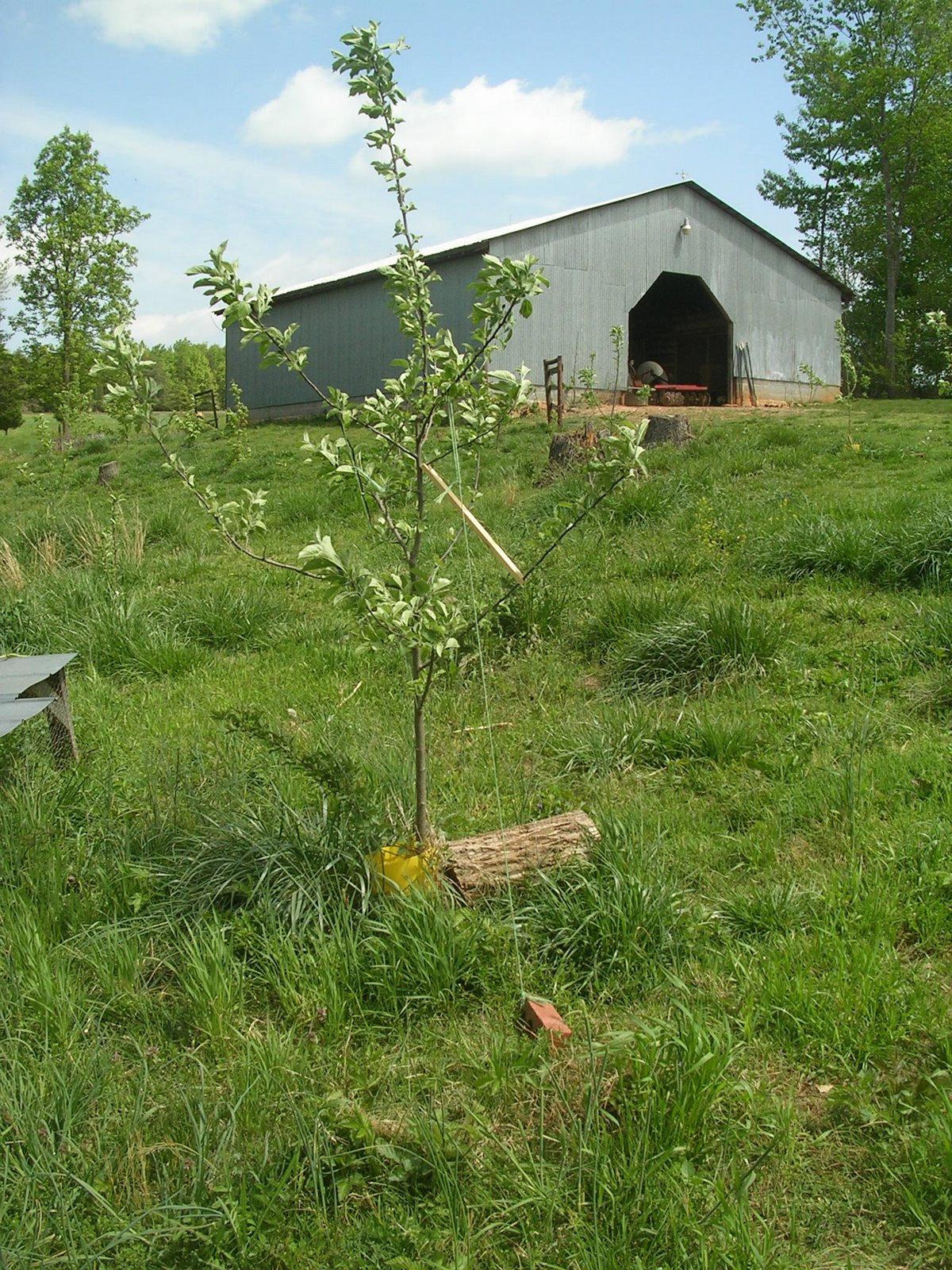
Within days of moving to our farm three years ago, we started planting fruit and nut trees. This spring, the orchard is finally starting to look like something. Many of the trees have grown over our heads (except the Asian pear the cow ran over) and some are putting out their first blossoms. This first planting is mostly an experiment to see what we can grow organically. We set out disease-resistant apples, some peaches, an apricot, some cherries, pears and Asian pears, persimmons, jujubes, figs, chestnuts and pecans. Along with these trees, we have grapes, blackberries, blueberries, and raspberries. We look forward to someday soon taking an edible walk around the farm.
Posted by Picasa

Wednesday, April 21, 2010

Crimson Clover - Food for bees, cows, and garden

Last fall, we sowed most every open space we had to crimson clover. Over the winter, it grew into a lush green mat, protecting the soil. Then this spring, it burst into bloom. But the clover is not only beautiful, it's a great food source for much of our farm. The bees have been busy working the blooms, collecting its nectar and pollen. In the pasture, Elsea and Mary May have been gorging themselves on it, resulting in increased milk production. We also cut some of the clover for hay, a treat for the girls this winter. And in the gardens the incorporated clover will decompose and provide valuable nitrogen for our garden crops.
Posted by Picasa

Saturday, January 30, 2010

KNOWING WHERE YOUR FOOD COMES FROM

This week we want to share with you all the biggest reason why we believe in local farms, which is also to explain why we do what we do. We believe in local farms because knowing where your food comes from genuinely empowers the consumer, enabling the consumer to make wise and responsible decisions about what to put on the table. Buzz words (like "free range" or "pesticide free" or "USDA organic") on labels of products from far away farms, on the other hand, more often mislead consumers and take advantage of the absence of any direct accountability to the consumer. This not only means inferior food on the table, but it means irresponsible and exploitive farming. We believe the only reliable source of good food is good farming, and we think good farming can only be sustained by wise and responsible consumption. You see, even more than the food itself, we believe in the kind of system that naturally produces good food and that produces it responsibly. Consider these questions: Does it matter at all how much fossil fuel is burned to substitute for natural fertility? Does it matter at all if farming depends on an immigrant underclass? Does it matter at all if insects pests are controlled by broad-spectrum insecticides (meaning they kill a huge range of insects instead of targeting the problem specifically)? Does it matter at all what impact the farm has on the human community that surrounds it? Do fields, pastures, gardens, and forests not have any more value to the local community than the dollars they generate? Does it matter at all if irrigation empties underground aquifers and causes rivers to run dry? The national organic standards, incidentally, say nothing about every one of these questions, but we believe these kinds of questions are ultimately inseparable from maintaining food quality. So the big question is: what kind of system allows a consumer to ask these kinds of questions? We think the answer is a system where the consumer knows the farmer, talks to the farmer, has a basis to trust the farmer, where the consumer knows the farm itself firsthand: sees the animals, sees the condition of the land, sees the farmer at work, etc. We think this kind of system: small-scale, diverse, local farming, naturally tends toward the production of good food. We all know where the industrial system of food production naturally tends. Do we want to naively try to tame the inherently irresponsible and exploitive system of industrial food production, or do we want to build and support the kind of food system that's consistent with good food, healthy ecosystems, and healthy communities?